
The Big Beautiful Bill's Impact on Onsite Energy
Business cases improve in the short term. Act now.
Webinar Recording
On July 4, President Donald Trump signed into law the Big Beautiful Bill, a massive spending and budget bill that made changes to tax credits and rules around clean energy technologies. Find out how these new rules impact onsite energy project economics and get our guidance for maximizing available incentives and setting a profitable, resilient and sustainable energy strategy.
What we cover:
- Updates to tax credits for clean energy projects
- Changes to asset depreciation
- Project-level and portfolio-wide economic analyses for solar + battery storage projects
- Deployment timeline considerations
- Guidance on progressing your energy transition plans
The Start of a New Phase in Distributed Generation Deployment
Perspectives from VECKTA CEO, Gareth Evans, on how businesses should be thinking about the changes the One Big Beautiful Bill brings and the opportunity to drive profitable energy solutions forward.
The “Big Beautiful Bill” just passed in the U.S., and if you read all the press and listen to some of the noise in the market, you’d think it’s time to throw in the towel. Race over!
But that’s not the case.
This isn’t the end. It’s the start of a new phase of the race. Sure, the terrain just changed. Incentives are shifting. Some provisions got trimmed. The confidence of some is knocked. But just like Alpecin–Deceuninck at the Tour, we’ve seen this all before, and change is the only constant.
If you had a singular vision and a static plan, you would be impacted. But if you’ve been building your strategy with eyes open or are open to adapting, you’re in a great position to lead. That’s why I’m still incredibly bullish. Here’s why:
Inevitable Trajectory
The pain points are becoming undeniable. Energy isn’t a nice-to-have; it’s the foundation of your business. As discussed in this article, incentives are great, but they are no longer the metric that makes projects viable or not. If your costs are volatile, your margins are at risk. If your power isn’t reliable, your operations are exposed. If your sources aren’t clean, your stakeholders will push back. The idea that you can outsource your energy strategy and hope for the best? That era is over.
Urgency
The revised landscape creates urgency. For years, companies could afford to wait. Incentives weren’t going anywhere, so there wasn’t much reason to move fast. But as pain points mount, that window is now narrowing. Instead of having tax credits for solar through 2035, they are now available for projects that begin construction within one year of enactment (by 7/4/2026) if placed in service within 4 years, OR begin construction after 7/4/26, they must be put into service by 12/31/2027 to qualify. Businesses that act today will lock in long-term value that is financial, operational, and reputational. Waiting just got expensive.
Innovation
The incentives that matter most are still intact. Battery storage in particular remains a massive opportunity. It’s not just about backup power, it’s about unlocking stacked value: load shifting, demand reduction, grid services, and more. Battery tax credits are protected through 2033. They will increasingly be a key component of onsite energy systems moving forward, where it makes economic and operational sense.
Capital Availability
Capital is no longer a constraint for this market; there is dry powder available to companies who want to secure financing for their projects. That said, one major and very positive update is the reinstatement of 100% bonus depreciation, up from 40% in 2025 and previously set to phase out entirely by 2027. Being able to depreciate onsite energy equipment by 100% in the first year makes the economics of projects even more compelling. Done right, behind-the-meter systems aren’t a sunk cost; they’re an asset, and access to capital isn’t a barrier to action.
Process Efficiency – The soft costs that have plagued our industry, such as high origination costs, unclear processes, fragmented solutions, long procurement timelines, interconnection delays, unique contracts for every project, and more, are being streamlined. This, combined with ongoing equipment price reductions, increasing energy costs, outage impacts, and stakeholder pressure (direct penalties, regulatory, contractual, or brand), will more than ensure onsite energy projects are economically viable and extremely valuable vs passive energy consumption from the grid.
Frequently Asked Questions
If a solar project is completed by 12/31/2025, does the 30% base ITC apply?
Yes, if a solar project is completed by the end of 2025, it qualifies for the 30% ITC and any additional qualifying adders.
When must a project be completed to qualify for bonus depreciation?
The “One Big Beautiful Bill” restores and makes permanent the 100% bonus depreciation provision first introduced in the 2017 Tax Cuts and Jobs Act, allowing companies to immediately write off the full cost of qualifying equipment in the year it is placed in service. Specifically:
100% bonus depreciation applies to qualified property acquired and placed in service after January 19, 2025, with no scheduled phase-down.
This means businesses can deduct the entire purchase price of eligible equipment and property in the first year, rather than depreciating it over several years.
What are the material cost ratio limits for PFEs?
Until further guidance is given, the “material assistance cost ratios” are:
- Begin construction in 2025 = no restrictions
- Begin construction in 2026 = above 40% (solar) and 55% (storage) from non PFEs
- Begin construction in 2027 = above 45% (solar) and 60% (storage) from non PFEs
More Resources

Ep 124: VECKTA’s $11M Series A and What It Means for Onsite Energy Buyers
What if businesses could stop being price takers in the energy market and start taking control of their energy future? In this episode, the entire VECKTA founding team celebrates its $11 million Series A funding round and explores why on-site energy is becoming an...
How to buy onsite energy systems from a place of control
How you buy onsite energy systems is the biggest lever you control. Buyers who know what they need before going to market and make suppliers compete on the same information can cut procurement to 9-12 weeks. Projects run this way consistently come in 20-45% below the...

Top Moment from Energy Innovation’s Robbie Orvis on What Is Actually Driving Up Electricity Rates
Why are electricity prices continuing to rise? And what does government policy have to do with it? In this highlight episode, Robbie Orvis, Senior Director of Modeling and Analysis at Energy Innovation, breaks down the real-world impact of the One Big Beautiful...
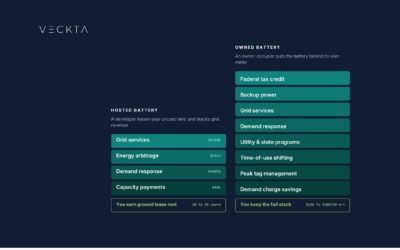
The Battery Value Stack for Property Owners and Owner Occupiers
Commercial and industrial property owners can earn an annual payment to lease unused parking, yard or outparcel space to a battery developer. The developer pays for, builds and runs the battery, and earns its revenue by stacking several grid programs. Capacity...

Ep 123: Getting Paid for Grid Flexibility with Grid Rails CEO Michael Grasso
The energy grid is becoming more dynamic, but the way we interact with it hasn’t always kept pace. Michael Grasso, Founder & CEO of Grid Rails, is working to change that by making it easier for utilities, businesses, and consumers to connect, control, and...

Top Moment from Utility Data as a Sustainability Planning Tool With Sagiliti’s DeVynne Farquharson
In this highlight episode, DeVynne Farquharson explains how organizations can use utility data to uncover cost savings, improve operational efficiency, and build practical sustainability strategies that deliver measurable results. You'll learn how utility bill...
